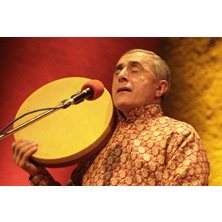
Alim and Fargana Qasimov, vocal and daf, (Azerbaijan)
accompanied by: Rauf Islamov (kamancha), Ali Asgar Mammadov (tar)
Alim and Fargana Qasimov
Alim Qasimov (b. 1957) and his daughter Fargana (b. 1979) exemplify the explosive artistic energy that results when a powerful musical model ignites the spark of young talent. “To be a musician, there has to be a fire burning in you,” explained the elder Qasimov. “It’s either there or it isn’t. I’m convinced that if young people have this spark – call it inspiration, call it spiritual fire – they can perform any kind of music. It could be pop, folk, or classical, but whatever it is, they’ll stand out.”
Fargana Qasimova’s talent gravitated naturally toward the music she heard from her father: Azerbaijani classical music, known as mugham, and the repertory of popular bardic songs sung by ashiqs – singer-songwriters who might be considered modern-day troubadours. Mugham may be performed in a purely instrumental form, but the performance medium most favored among Azerbaijanis is the voice. Vocalists typically perform the lead role in a trio that also includes tar and kamancha as well as a frame drum (daf) played by the vocalist. This trio style of performance provided the starting point for Alim Qasimov’s innovative treatment of mugham.
“We never put before ourselves the aim of singing mugham in the form of a duet or carrying out any kind of reform,” said Alim Qasimov of the sinuous vocal arrangements he performs with Fargana. “Rather, what we do appeared spontaneously in the process of rehearsing. We can do it one way in a rehearsal, and then in a concert, it will turn out completely differently. When I meet with the musicians in my ensemble, there’s an atmosphere that starts to nourish us that comes from beyond our own will, and that’s the source of the unpredictability in our music. It’s almost a feeling of ecstasy that leads to some kind of meditation.”
“Mugham is an elite art,” says Alim Qasimov. “It’s for a select group – for people who have some kind of inner spirituality, who have their own inner world. These days ‘elite’ refers to something more commercial than spiritual, but that’s not what I have in mind. An elite person is one who knows how to experience, how to endure, how to feel, how to listen to mugham and begin to cry. This ability doesn’t depend on education or upbringing, nor on one’s roots. It’s something else. It’s an elite of feeling, an elite of inspiration. I think there will always be an attraction to this music until the end of humanity.”
Alim and Fargana Qasimov:
“Chargah” or “Bayat-i Shiraz” (selection made by the performers prior to each concert)
Text: Seyyid Azim Shirvani (1835-1888) [Chargah] Muhammad Füzüli (16th century) [Bayat-i Shiraz]
Music: Traditional, arranged by Alim Qasimov
“Chargah” and “Bayat-i Shiraz” comprise two of the seven principal suite forms of Azerbaijani classical music. Each suite consists of a conventional sequence of pieces that take listeners on a journey through varied musical and emotional terrain. Throughout each suite, high dramatic tension contrasts with moments of repose and détente. Lively, dance-like intermezzos (reng) link the longer vocal pieces in which both singers and instrumentalists seamlessly fuse memorized and extemporized sections of music. Throughout the suite, melodies modulate through different tonalities or modes, and at the end of this modal journey, the melody finally returns to the initial pitch, bringing the suite to a close.
Description of Musical Instruments
Daf: Frame drum of different sizes that is the principal percussion instrument of Badakhshan, and is also played in Azerbaijan.
Kamancha: Spherical spike fiddle with a cylindrical neck fitted with four steel strings.
Naghara: Cylindrical double-sided frame drum played with hands rather than sticks.
Tar: Double-chested plucked lute used in urban music from the Caucasus and Iran. In Azerbaijan, the tar is widely considered the national instrument.