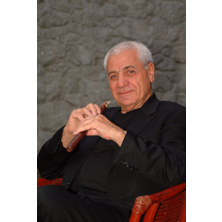
DJIVAN GASPARYAN
Armenia
Djivan Gasparyan is unquestionably one of Armenia's greatest musicians, a living legend and one of the world’s great musicians. He is the foremost virtuoso of the duduk, an ancient oboe-like instrument that is made of apricot wood and capable of sustaining drone notes for long periods of time. It is said that no other instrument is able to convey the emotions of the Armenian people as well as the duduk. In the hands of the master musician the duduk becomes the vehicle for haunting and meditative music that eloquently evokes the Armenian landscape and its people.
Armenia's most famous folk musician was born in 1928, in Solag, a village near the Armenian capital Yerevan. He began to play the duduk at the age of 6 gaining much of his knowledge by listening to the great masters. He won Gold Medals in four world-wide competitions organised by UNESCO in which he competed(1959, 62, 73 80). In 2002 he won the WOMEX award for a lifetime contribution to music. He has the unique distinction of being the only musician to be given the honorary title of People's Artist of Armenia in 1973. A professor at the Yerevan Conservatory, he has prepared many duduk musicians for professional performance. Currently establishing an international school of duduk in Yerevan, he greatly enjoys teaching and it brings him joy to know that, through his efforts the tradition of duduk playing will not be lost.
Gasparyan has toured Europe, Asia and the Middle East. In the US has performed extensively in New York and Los Angeles (where he appeared with the LA Philharmonic). His recording of a selection of Armenian folk songs and ballads entitled I will not be Sad in This World, (1989) dedicated to the victims of the Armenian earthquake has received worldwide recognition. He has collaborated with Lional Richie and has recorded soundtracks for 18 films including RussiaHouse, The Crow, and Atom Egoyan's film Calendar, the American Hungarian television co-production Storm and Sorrow, in 1999, The Seige (Bruce Willis, Denzel Washington), Onegin (Ralph Finnes) Blood Diamond (2006) and in 2000 the Oscar winning Gladiator. He was invited to perform at the Nelson Mandela Concert in London in 2008.
Djivan Gasparyan's duduk repertoire is primarily comprised of traditional Armenian folk songs. He is also an accomplished singer in the folk tradition and a composer. In addition to his original compositions and arrangements of traditional songs, he has written love songs based on the poetry of Vahan Derian. On tour he is accompanied by three duduk players, offering audiences the full range of the duduk (soprano, tenor, baritone and bass). One of the group members is his grandson also called Jivan Gasparyan who is a great talent in his own right.
Discography
I Will Not Be Sad in This World - Opal/All Saints
Moon Shines at Night - Opal/All Saints
Ask me no questions - Crossroads
Apricots from Eden - Crossroads
The Crow (sound track)
Black Rock with Michael Brook - Realworld 1998
Djivan Gasparyan Quartet - Libra Music 1998
The Seige (sound track)1998
Heavenly Duduk - Network 1999
Armenian Fantasy – Network 1999
Cosmopoly Andreas Wollenweider and Friends –1999
Eden Rock (with Ludovico Einaudi) - 1999
Gladiator(sound track) 2000
Double cd celebrating Jivan’s life’s work from Network October 2007
Reviews
Gasparyan devoted nearly all of his concert to slow songs, and he turned nearly every one into a quiet riveting drama, elegiac, sultry, nostalgic, reverent - Jon Parales New York Times
haunting...beautiful...one develops an emotional attachment to this music that is so strong that even the most minuscule bit of surface noise seems like an unholy violation of trust between musician and audience - LA Weekly
Without doubt one of the most beautiful and soulful recordings I have ever heard (I Will Not Be Sad In This World) - Brian Eno
The DUDUK
The Duduk is a traditional Armenian wind instrument of apricot wood, defined by Groves Dictionary as "a cylindrical wooden oboe...whose tuning is untempered" (ie microtones are used, or pitches that lie between half tones). The instrument has only one-octave range and its dynamics are controlled by means of lips and fingers. It is generally played to the accompaniment of a second dam duduk, which gives the music energy and tonic atmosphere as it changes scale with the principle duduk.
The duduk has a 1500-year history in which it plays an essential role in Armenian folk traditions. Travelling Armenians have taken the instrument to Persia, Azerbaijan, Turkey, the Middle East and as far as the Balkans where derivatives of the duduk are played. However, it remains a uniquely Armenian instrument.