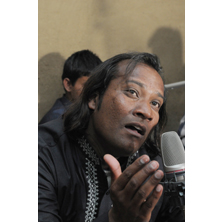
Raza Khan is Sufi singer, musician and composer who lives a simple life despite his musical genius. He was born in Batala (Punjab) and started learning music at the age of 7 under Ustad Shafqat Ali Khan, who belongs to Sham Chourasi Gharana, a five hundred year old musical tradition from Hoshiarpur, Punjab (a state in northern India). Raza Khan is also affiliated to the Mausiki Gharana tradition. His ancestors were related to Tansen, one of the greatest exponents of Hindustani classical music. Raza Khan displays an extraordinary vocal range that parallels the accompaniment of the harmonium regardless of the upper or lower range it may exceed to. He makes the transition from modular vocals to falsetto with ease and his vocal style is characterized by long sustains in the upper register. It is this style that distinguishes him from other mainstream Sufi artists.
Raza Khan is one of the most talented living Sufi singers, musician and composer from the town of Amritsar, India. The transition from modular vocals to falsetto with unusual ease and the long sustains in upper register set him apart from other mainstream Sufi artists in the world. He sings Sufi poems in the form of Ghazals, Qawwalis, Kalams and Kafi, mostly in Urdu and Punjabi, to the tunes of Harmonium and rhythm of Tabla. He started learning music at the age of seven under Ustad Shafqat Ali Khan, who belongs to a five hundred year old musical tradition from Punjab. He enchants with an extraordinary vocal range and extreme emotional intensity of the performance.
The Sufi methodology of reclamation of the soul from the worldly and its upliftment through music and poetry to reach out to the eternal, godly element finds an unparalleled exponent in Raza Khan- a Sufi singer, musician and composer from the town of Amritsar, India. True to the Sufi tradition he sings the insightful lyrics of Sufi poets in the form of Ghazals, Qawwalis, Kalams and Kafi mostly in Urdu and Punjabi, to the tunes of Harmonium and ryhthm of Tabla. He was born in Batala (Punjab) and started learning music at the age of seven under Ustad Shafqat Ali Khan, who belongs to ‘Sham Chourasi Gharana’, a five hundred year old musical tradition from Hoshiarpur, Punjab. Raza Khan, a devout Christian is a paradigm of the secular tenets of Sufism and is also a proponent of the ‘Mausiki Gharana’ tradition. His ancestors were related to Tansen, one of the greatest exponents of Hindustani classical music. He displays an extraordinary vocal range that parallels the accompaniment of the harmonium regardless of the upper or lower range it may exceed to. The transition from modular vocals to falsetto is made with characteristic ease and his vocal style is distinctive by virtue of long sustains in the upper register. It is this style that sets him apart from other mainstream Sufi artists in the world. His music displays completeness in its simplicity however the intensity of his performances enables the listener to identify extensively with the feelings of surrender and devotion to the Almighty.
Raza creates an ambience of devotion through unique Sufi Kalams (Songs). Each Kalam connect the listener with the supreme power. His music makes use of instruments such as the Harmonium and Tabla while rhythmic claps are used as embellishments. The compositions in this album are semi-classical in nature and have been improvised upon and performed by Raza Khan himself. Raza’s objective is to create his own variation of traditional art and he continues to incessantly work towards the same.
Instrumentation
Raza Khan - indian harmonium
Harmonium Player - indian harmonium
Tabla Player - Indian Tabla
Four Backing Vocalists
Discography
Call of the Soul
Glimpse of Punjabi Music
Unheard Punjab